
No Bad Parts
Where Traditional Leadership Models Fail Us

One of the greatest challenges of leadership—especially for women—is that we often compartmentalize or even demonize different parts of ourselves. We praise the strategic, polished, high-performing parts, while criticizing or suppressing the vulnerable, fearful, or reactive ones.
But what if wholeness means welcoming all of it? What if, as Dr. Richard Schwartz writes in No Bad Parts, there are truly no bad parts within us—only parts that are trying (sometimes desperately) to protect us?
This week, I met a part of myself I call Survival Natalie. She’s different from Strategist Natalie, who loves structure and vision. Survival Natalie shows up when I feel under pressure, when the stakes are high, and when fear tries to run the show. She’s reactive, envious, hyper-critical—and yet, she’s also trying to keep me alive, safe, and tethered to what she knows.
Being a Nourished Leader means recognizing these parts, listening to them with curiosity instead of shame, and learning how to integrate them so we can lead from wholeness. Because if I can learn to work with all the parts of me, I can better hold space for the many parts that live in others, too.
Below is an excerpt from my own journal this week, where I reflected on what it might look like to stop resisting Survival Natalie and instead let her become my teacher.
Journal Entry - Survival as Teacher
I’ve always resented survival mode. It feels like the thief of my peace, the constant shadow reminding me that I am one bill, one diagnosis, one wrong turn away from collapse.
But today I’m entertaining a different possibility: maybe survival isn’t my enemy at all. Maybe - she’s a teacher I’ve overlooked.
What if survival isn’t here to shame me for not being further along, but to sharpen my instincts for when the path isn’t clear? What if she isn’t just the pressure on my chest, but the voice that says, keep breathing, keep moving, keep noticing?
I know survival mode is temporary, yet instead of resisting it - perhaps the invitation is to walk with her long enough to learn what she has to teach me: courage in the face of uncertainty, discernment when the noise grows too loud, and humility to remember I am still becoming.
Why does this matter?
Traditional leadership models often demand that we leave parts of ourselves at the door. They prize the polished, rational, “productive” side of us, while dismissing the messy, fearful, or vulnerable parts. But in reality, those parts never disappear—they just go underground and show up in ways we don’t always recognize.
Did you know that research shows leaders who practice self-integration (acknowledging and working with their different parts) build 45% more trust within their teams than those who lead from suppression and compartmentalization?
Wholeness isn’t just personal—it ripples into culture, performance, and collective wellbeing.
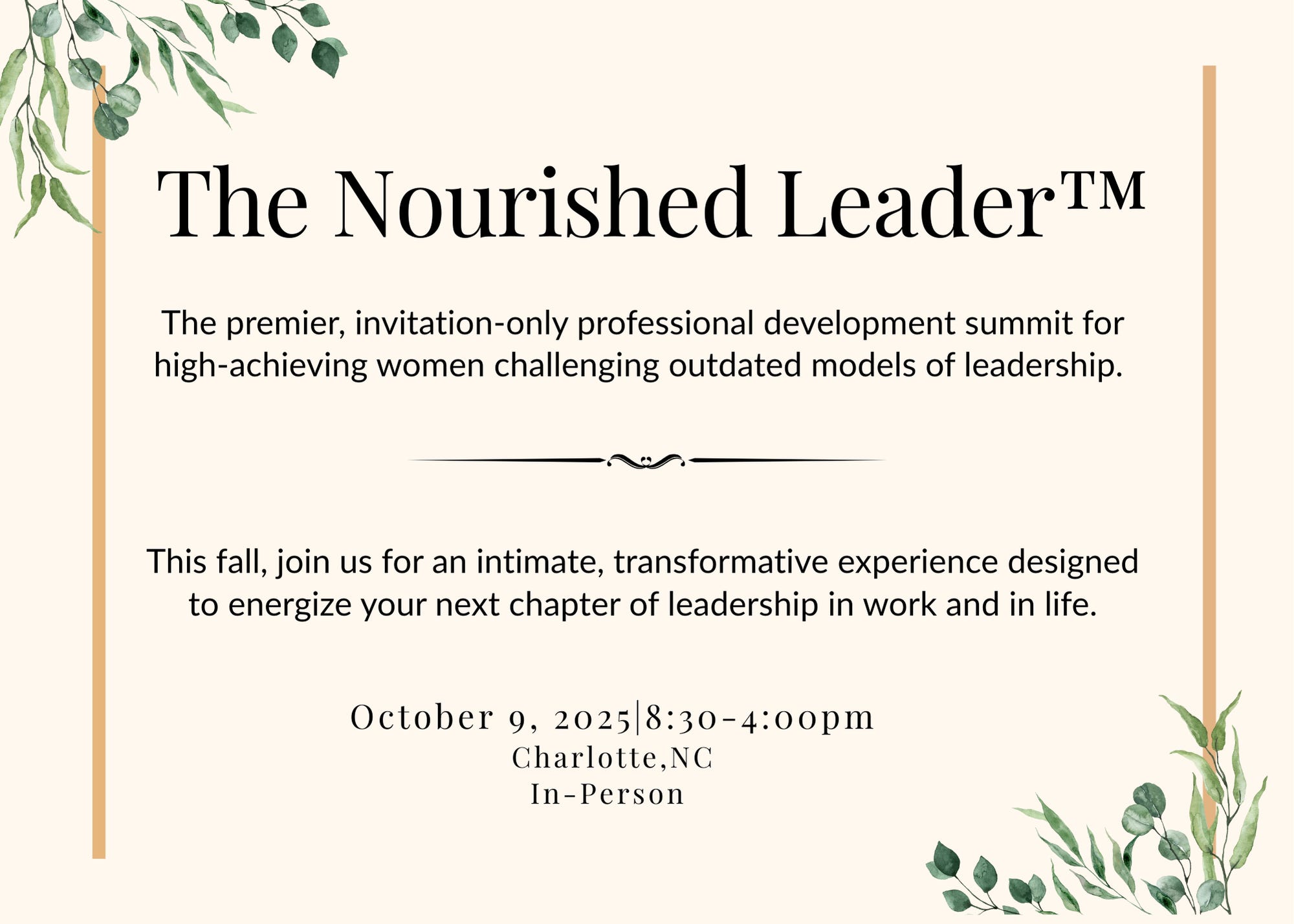
At the Nourished Leader Summit - 2025 in Charlotte, NC, we’ll be exploring exactly this: how to move beyond outdated leadership paradigms and into a model that makes space for all of who we are—and, by extension, all of who our people are.
Because when we integrate ourselves, we create the capacity to lead others more fully. And that’s what leading nourished is all about
Leadership is evolving—and so must we.