
The Most Dangerous Sentence in Leadership: “I’m Certain.”
Why women navigating complex lives must learn to move forward without perfect answers

There’s a fascinating pattern researchers and leadership thinkers have noticed.
People who have lived through complex, uncontrollable conditions—serious illness, caregiving, or long-term uncertainty—often develop a different relationship with certainty and judgment than those whose lives have been more predictable.
I recognize that pattern because of my experience living with sickle cell disease.
When I went through my journey of sickle retinopathy that ultimately left me without vision in my left eye, the moments that stayed with me most were the 1:1 conversations I had with my eye doctor toward the end of the process.
At the beginning, the odds were in my favor. There was an 80% chance I would not lose my eye. But over the course of a year and a half, those odds slowly collapsed until we were facing a very different reality.
Even sitting in the room with the expert—the person with the most knowledge about what was happening— at the time the outcome was uncertain AND unknowable.
Here’s what I realized:
Our early leadership experiences tends to focus on proving knowledge, asserting judgment, and solving problems quickly.
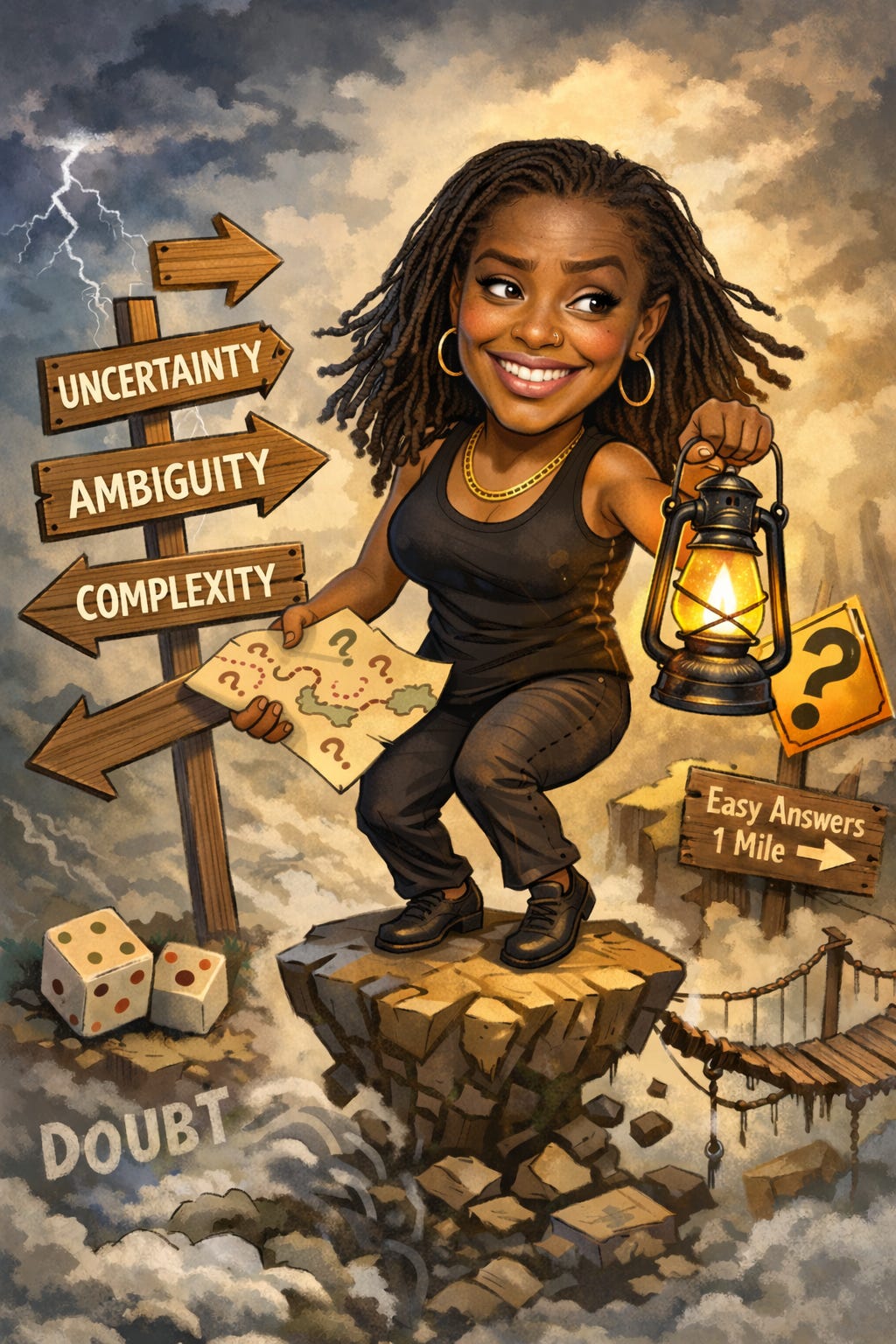
But later our leadership MUST become more comfortable with our capacity to embrace uncertainty and navigate ambiguity - including holding multiple truths at once.
Some situations cannot be solved with certainty.
They can only be navigated.
And experiences like illness, caregiving, or long periods of uncertainty tend to develop three leadership capacities that many people never learn any other way.
First, you recognize the limits of control. When you live with something like a complex or unpredictable illness, you quickly learn that information does not equal control. Expertise does not eliminate uncertainty. And decisions often involve trade-offs without clear answers.
Do: Practice empathy by softening the impulse to force certainty in other people’s decisions.
Second, you become more attuned to invisible realities. People living with chronic conditions constantly carry realities that others cannot see.
Pain. Fatigue. Risk calculations.
Do: Learn that someone’s reasoning may make perfect sense inside their reality—even if it looks irrational from the outside. This builds a muscle most leadership programs try to teach but rarely achieve:
Epistemic humility — the recognition that your perspective is incomplete.
And third, you begin to understand that hope itself can become a legitimate strategy.
In environments of high uncertainty, hope is not naïve. It becomes a functional resource. Psychologists studying chronic illness and resilience often find that hope does something certainty cannot. It helps people:
adhere to treatment longer.
maintain a stable sense of self.
stay oriented toward the future.
Hope allows people to keep participating in life despite uncertainty. And because of that, the practices that sustain hope begin to matter more.
Small rituals.
Daily routines.
Moments of faith.
Even a little mysticism. ( My personal favorite!)
From the outside, these practices can look irrational. But inside uncertainty, they are often what allow people to keep moving forward.
In that sense, hope isn’t wishful thinking. It becomes a strategy for survival.
These capacities change how you make decisions. They change how you interpret other people’s choices.
Because once you have lived inside “true” uncertainty, something becomes clear.
Insisting on certainty in complex situations is dangerous.
It leads to premature decisions. It minimizes context. It produces conclusions that are too neat for the reality in front of us. And it silences that which might have led to better outcomes.
For women in particular, this tension shows up in a very personal way.
1. It makes us abandon our own complexity
Many women are living inside multiple truths at the same time:
career ambition and caregiving
financial responsibility and health limits
leadership expectations and emotional labor
competence and uncertainty
We the often force ourselves into simpler narratives than our lives actually allow.
2. It traps us in over-proving
I see more and more women chasing more credentials, more proof, more preparation.
That impulse often comes from the belief that:
If I just know enough, I’ll finally be right.
But real leadership rarely offers that moment of perfect certainty. Without the capacity for ambiguity, women can get stuck in perpetual proving instead of stepping into authority.
3. It shortens our thinking
When we insist on being certain, we rush toward answers. When we insist on being right, we rush toward answers.
But complex lives require something different.
They require the ability to sit with the situation long enough for better understanding to emerge.
In sum: Developing the capacity to hold ambiguity allows us to:
make decisions without perfect certainty
stop forcing ourselves into impossible standards
move forward without needing every answer first
It gives us room to lead our lives honestly.
My experience with illness taught me long ago that certainty is often an illusion and that leadership maturity is not about eliminating uncertainty.
It’s about developing the capacity to move forward without it.
This is always what led me into executive coaching and advisory work.
Because the self-leadership capacities required in complex situations—recognizing the limits of control, seeing invisible realities, and navigating ambiguity without forcing certainty—are rarely developed through credentials or traditional leadership training.
They are developed through disciplined reflection, rigorous thinking, and conversations that allow leaders to see themselves and their situations more clearly.
As the saying goes, you can’t read the label from inside the bottle.
If you’re a woman leader navigating health challenges, transition, and the pressure of performing in high-level roles, feel free to reach out.
I have two spots open in April for one-on-one executive coaching.
Thank you for reading The Nourished Leader™.
The Nourished Leader™ develops women leaders who rise in uncertainty, command ambiguity, and transform complexity into the power, presence, and position required to lead.
— Natalie R. Legrand
Owner, The Nourished Leader™
What’s Happening
Thursday Masterclass | April 16 | 4:00–5:30 PM EST
For Financial Literacy Month, I’m sharing my $6,000 - less than 20hrs a week 90-day Uber experiment in Charlotte and what it revealed about bridge income, professional identity, and financial agency during career transitions. Bonus: I’ll also share the exact strategy for making money with Uber in Charlotte, NC.
Women, Money & Self-Trust
A Financial Strategy Clinic
📍 Highland Creek Golf Course
🗓 Monday, May 4
⏰ 10:30 AM
🍽 Lunch provided
Register here: Women, Money, & Self-Trust