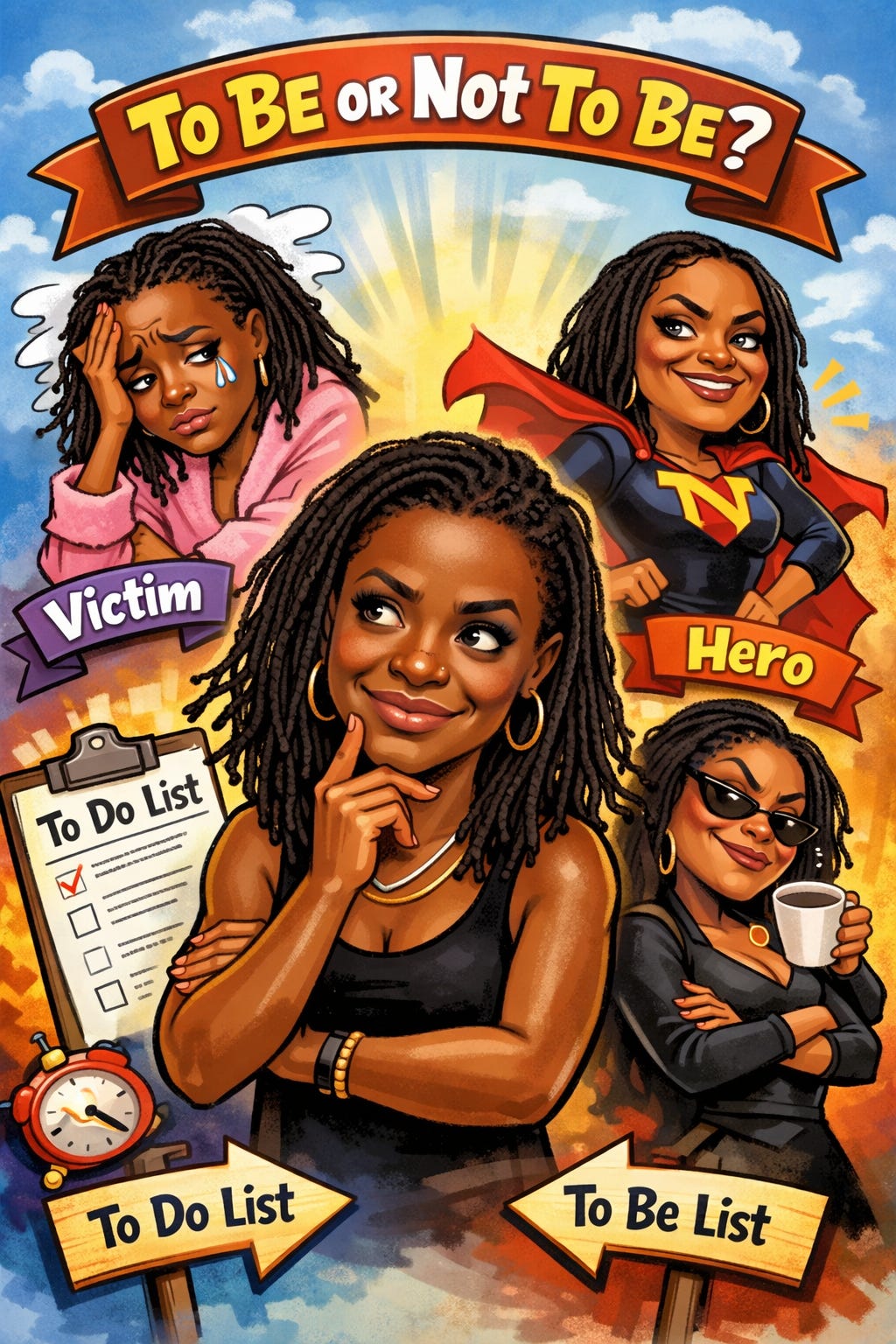
To Be or Not To Be: Why I Stopped Writing To-Do Lists

Self-leadership begins the moment we stop organizing our lives around what needs to be done and start anchoring our days in who we choose to be.
I’ve always had a problem with to-do lists.
Not because I’m disorganized. Not because I don’t believe in productivity. But because, quite literally, I never understood the assignment.
You see, when someone told me to make a to-do list, I assumed the task was to do the list.
So I did. I wrote it. List completed.
If the job was to create a to-do list, then technically, the moment the list existed… the task was finished.
And that’s exactly how it always felt to me.
I would write a beautiful list. Organized. Thoughtful. Clear.
Then something strange would happen.
My brain would quietly say: “Well done. You did the list.” ( It wasn’t wrong…)
And the rest of the day would move on.
For years I thought something was wrong with me. Everyone around me seemed to live and die by their to-do lists. Entire productivity systems were built around them. People swore by them.
Meanwhile, I felt like the moment I wrote the list. Task complete.
Side Bar: It turns out there’s actually a reason for this. Our brains release a small sense of accomplishment when we define a task, not just when we finish it. The act of organizing the work can trick the brain into feeling like progress has already occurred. Go figure!
But the deeper realization I had recently wasn’t about productivity at all.
The work of a nourished leader is not about becoming more productive. It’s about becoming more self-led. And self-leadership doesn’t start with what you do.
It starts with who you choose to be.
Most people structure their lives around to-do lists.
But I’ve started experimenting with something different: A to-be list.
Instead of asking: “What do I need to get done today?” I start by asking: “Who do I need to be today?”
Once those identities are clear, the actions follow naturally.
Mic Drop: The doing emerges from the being.
And here’s the surprising part:
When you start with being, more meaningful things actually get done.
Not because you forced productivity, but because your actions are aligned with identity.
The Issue with To Do Lists:
To-do lists reinforce what I now call task identity.
Task identity is the belief that your value—and even your identity—comes from completing tasks.
· If I accomplish this, then I am responsible.
· If I finish that, then I am productive.
· If the list is done, then I am successful.
Sound familiar?
The problem is that task identity traps people—especially women—in an endless cycle of responsibilities, checklists, and obligations that keep life moving but rarely move us forward.
What Happens When You Live from Task Identity
When your life is organized around doing instead of being, you often end up playing one of three characters.
The Victim
This is the moment when the list overwhelms you. You feel:
buried under responsibilities
resentful about how much is on your plate
exhausted from constantly reacting
The inner dialogue sounds like: “Why does everything fall on me?”
The Hero
So you push harder. You step in. You fix things. You take responsibility.
You become the one who:
handles the crisis
saves the situation
carries the team or the family
The hero gets things done.
But the hero is also constantly overextended.
The Villain
Eventually the exhaustion shows up as frustration.
You snap. You withdraw. You blame someone.
Not because you are actually a villain — but because the pressure finally spills over.
Now the inner dialogue sounds like: “Why can’t anyone else handle this?”
The Cycle
The trap is that task identity keeps you cycling through these three roles:
Victim → Hero → Villain → back to Victim.
All while the list keeps growing.
The problem isn’t your capability. It’s the starting point.
When your day begins with doing, you end up reacting to the system. When your day begins with being, you start directing your life instead of constantly rescuing it.
Which makes me think Shakespeare might have been onto something.
“To be, or not to be” wasn’t really a question about action. It was a question about identity.
And identity ALWAYS comes first.