Women To Know Wednesday: Erika Rosenthal
Leaders of leaders who are challenging the status quo and making a lasting impact.

In August, I was honored as one of the 50 Women to Know in North Carolina. I was so impressed by these leaders of leaders—women who are challenging the status quo and making a lasting impact in their communities. Over the next few months, I’ll be featuring some of their powerful voices here.
TL;DR
Erika Rosenthal, recognized as a “Woman to Know in North Carolina for 2025,” shares her entrepreneurial journey spanning three distinct decades: working for Fortune 500 companies, building her own medical spa business, and now helping mid-market companies scale through her firm, Veritac Group.
Erika emphasizes the importance of self-care before caring for others—contrary to her generation’s “others first” mentality. She believes nourished leadership is about helping others succeed rather than personal accomplishments.
Her key insight for women leaders is to overcome excessive self-criticism, which she describes as “dead weight” that hinders potential. When making high-stakes decisions, she recommends first finding clarity within yourself, then establishing common ground on the “what” and “why” before discussing the “how” with others.
Erika balances her professional life with being a mother of five adult children and a grandmother, finding fulfillment in this season of giving back and connecting with inspiring people.
Erika: I’m an entrepreneur at heart. I love seeing an opportunity and a need in the marketplace and trying to fill or solve that. I’ve made a very nonlinear career out of doing that.
My first decade was working for Fortune 500 companies. My second decade was building my own company, a medical spa that started in the 90s when we were still explaining what that was to the world, and growing that to multiple locations. I did that for a decade.
Now I’ve been helping other leaders for the last decade, helping them grow their businesses, which is what Veritac Group is. We help grow mid-market companies, help them scale and increase their revenue. I love this stage of life because I think for me it’s giving back and meeting so many incredible people, and that’s what really fuels me.
I’m also married and a mother of five adult children and one grandchild, so life is really full and good at this point.
What does leading nourished mean to you in this season of leadership?
Erika: It really means taking care of self and making sure that you’re investing in yourself so that you can do these other things. For my generation, it’s “take care of everybody else and then take care of yourself.” And that’s a fallacy.
I think that we’ve got to be in that equation of nourishing, of getting inspiration from others, of seeing others’ grit and determination, of lending a helping hand and helping somebody up when they fall down, and just showing up in a different way. I think it’s less about what we accomplish and more about how we help others succeed.
When you say self, what does that mean to you?
Erika: That’s a really good point. Self is complex, Natalie. It’s all of the things that get in the way. Those little voices that say, “Oh, I’m not the best one for this. Maybe there are lots better people to talk to and women to know.” It’s that little voice of self-doubt, or the voice that wants to pivot and present something that is greater than what it actually is at the moment.
I think that’s just a huge waste of time, and it doesn’t serve ourselves or each other to do that. It’s about being real, being authentic. We are all putting one foot in front of the other at times. And how do you flourish? You keep that inspiration and you keep helping others.
The definition of a nourishing leader is probably going to be very different for each person. What does it mean for you? For me? Those are different things. Being able to define that and say what keeps us showing up and getting up every day when there are hurdles to overcome.
What’s one shift women in leadership must make to sustain themselves and shape the future of work?
Erika: I think that as women we tend to be very self-critical. We always see what we can do better, or we do a replay: How could I have handled that last meeting or that last interaction? There’s nothing wrong with self-reflection, but when it comes down to being overly critical of self and not celebrating the gains and where we’ve come, and not showing up as a servant leader asking what we can do to help others, then it’s easy to pick apart and be our own dead weight.
It’s like a big ball and chain that just slows us down from our potential if we give that voice too much credence. It’s about thanking that voice for being there and saying, “Okay, these are things I could do better next time. That’s good. I’m going to move on and these are my takeaways.”
I think the self-criticism is one of those things that we can do better with, especially when the stakes are high and you need to make clear, confident decisions.
How would you describe the way you make decisions, especially in high-stakes environments, especially when that self-critic is extremely loud?
Erika: It’s a great question. First, I think that I’m having the conversation. If I’ve got to make a decision and decide where to go, I need to decide that with myself first and be confident in that. I listen to all the inner critics because the higher the stakes, the more tension there is, and the more I think we can fall into a trap of looking for approval from others.
But when you know the right way to go, you can pause and listen to a different point of view. That’s important. But it doesn’t have to derail you. Or if you’re working with somebody else, say, “Okay, we’re acknowledging X, Y, and Z, and we want to get to this point. In light of that, how do we get there together? What are the steps that should be taken?”
I think inviting others to come together to reach a common goal is key. It’s finding the common ground and not trying to make an argument or a statement or seek approval because we’ve already been through that very critical piece.
If we’re breaking down something and saying, “Based on all the information I have in front of me, this feels like the best direction to go,” and then pausing and saying the what and the why before we even get to the how. Is there agreement in the what and the why? And then we’ll talk later about how we’re going to do that.
Find that common ground first and gain that agreement before proceeding any further. I think if we can take the time to do that, then we’re doing a service for ourselves and for others.
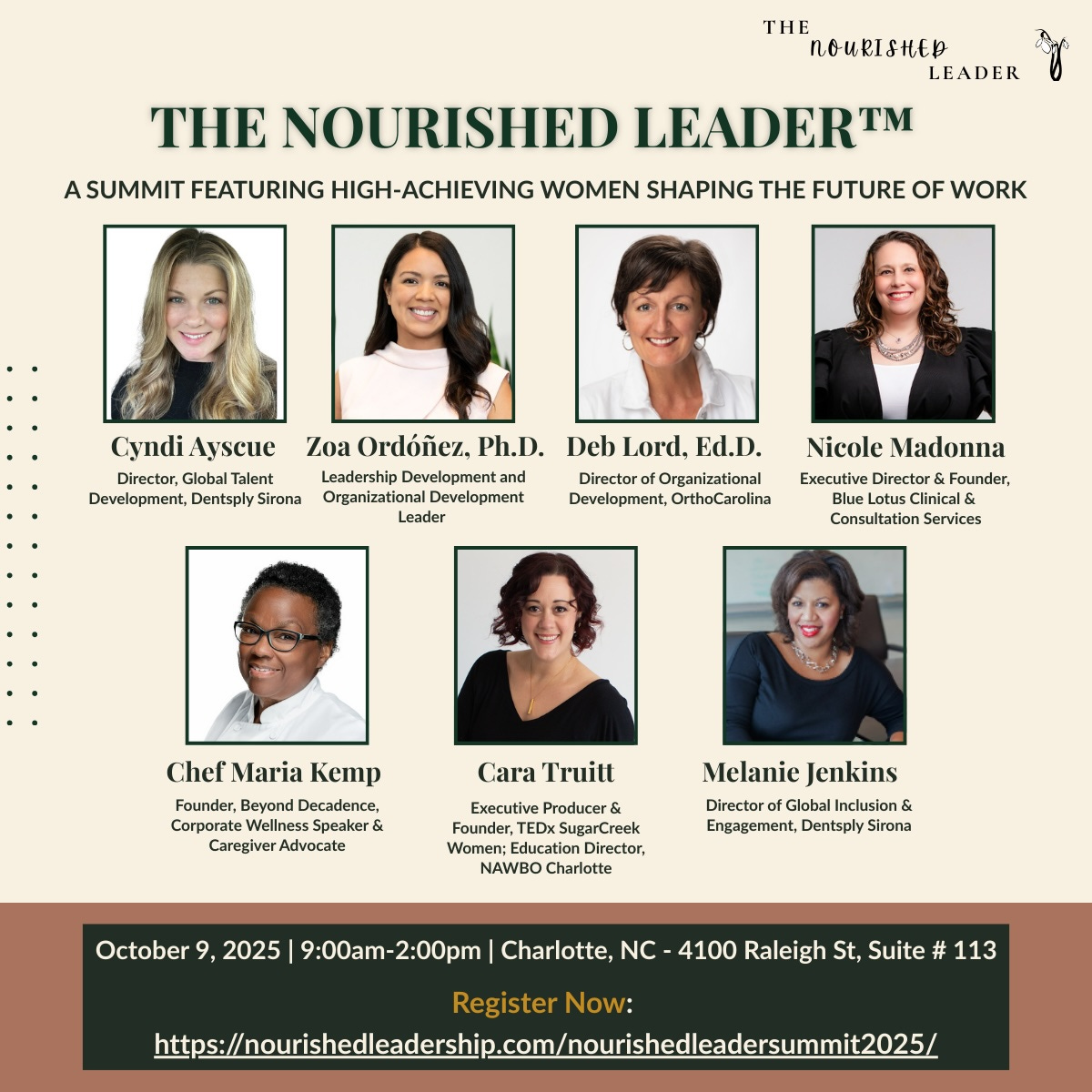
✨ We’re just two weeks away! ✨
I’m both excited and a little nervous as we count down to the inaugural Nourished Leader Summit. I truly believe in what we’re creating—a space where women leaders can be replenished, challenged, and inspired.
If you haven’t gotten your ticket yet, now’s the time. Reserve your seat today →
✨ Curious about who you’ll be learning alongside? Meet the remarkable panelists who will be shaping the conversation at the Nourished Leader Summit.